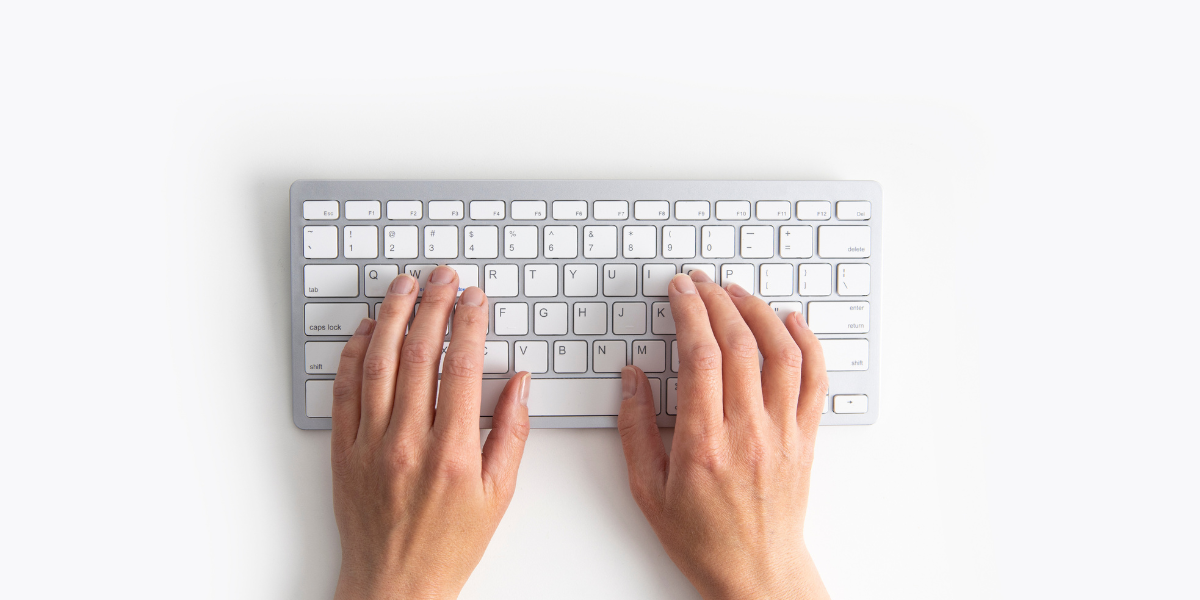
Most people practice typing with easy and simple words, and then wonder why their typing becomes slow and messy while writing something in real life. Real typing is not only about lowercase words. It also includes punctuation, capital letters, numbers, symbols, and many small movements that can easily break your typing rhythm.
If you want to improve your practical typing speed, you need to practice the things that you actually use while writing emails, messages, articles, documents, comments, or code. In this guide, we are going to discuss what you should practice so your typing improves everywhere, not only inside easy typing tests.
First, aim for clean typing
If you want to type faster, first make your typing cleaner. Clean typing means you can type a complete sentence without panicking, pressing Backspace repeatedly, or looking at the keyboard every few seconds.
Your fingers should move at a speed that you can comfortably control. You should not feel like you are fighting with the keyboard or forcing your hands to move faster than they can handle.
- Target accuracy: Try to maintain around 97% to 99% while practicing.
- Target feeling: Your typing should feel calm, steady, and repeatable.
- Target habit: Keep your eyes on the screen instead of looking down repeatedly.
Once your hands start moving smoothly and making fewer unnecessary movements, speed starts showing up as a side effect.
You should not try to become faster by forcing every keypress. You should become faster by removing the mistakes, pauses, and awkward movements that are currently slowing you down.
Why easy word tests are not enough
Easy word tests are useful when you are learning the keyboard or warming up your fingers. But they do not completely represent how you type in real situations.
Real sentences include commas, full stops, apostrophes, capital letters, numbers, brackets, and many other symbols. Your speed may look good on easy words but drop suddenly when these keys appear.
That is why your practice should include both simple word drills and real sentences. Easy drills help you improve basic finger movement, while sentence practice prepares you for normal typing.
Fix the biggest real-world bottleneck: punctuation
Punctuation is where many typists slow down. It is not always because punctuation is difficult. The main reason is that many people do not practice it enough in normal word drills.
The moment you start typing emails, comments, articles, notes, or code, punctuation appears regularly. If your fingers are not comfortable with these keys, every punctuation mark will break your flow.
Practice punctuation in small groups
Do not try to learn every punctuation key in one session. Start with the most commonly used keys and slowly add the others.
- Full stop followed by a space:
. - Comma followed by a space:
, - Apostrophe:
'in words like don’t, I’m, and you’re - Hyphen or dash:
-in words like well-known and follow-up - Colon and semicolon:
:and; - Question and exclamation marks:
?and!
The full stop and comma should be practiced first because they are used in almost every paragraph. Once these keys feel natural, move to apostrophes, question marks, quotation marks, and other symbols.
A few minutes of targeted punctuation practice can be more useful than completing several random typing tests.
Practice the space after punctuation
Many people focus only on pressing the punctuation key, but the movement after it is also important.
For example, after typing a comma or full stop, you normally need to press the spacebar. This complete movement should become a single smooth pattern.
Instead of thinking about the comma and spacebar separately, practice them together as , and . .
This helps your fingers move naturally into the next word without creating a pause.
Learn to type capital letters without breaking rhythm
The Shift key is another common source of tension. Some people lift their complete hand or twist their wrist while trying to type a capital letter.
This small awkward movement can break your rhythm and make the next few letters slower.
A simple rule can make capitalization easier: use the Shift key with the hand that is not typing the letter.
- For letters typed with the left hand, press Shift with your right hand.
- For letters typed with the right hand, press Shift with your left hand.
For example, if you want to type a capital A, use your left pinky for A and your right pinky for Shift. If you want to type a capital P, use your right pinky for P and your left pinky for Shift.
You do not need to become perfect immediately. You only need to build one consistent habit so your hands stop guessing whenever a capital letter appears.
Practice capitals inside real sentences
Do not only practice single capital letters. Type short sentences that include names, places, days, and words at the beginning of sentences.
For example:
- John went to Delhi on Monday.
- I started learning typing today.
- My favorite subject is English.
This helps you combine Shift, letters, spaces, and punctuation in the same movement.
Do not forget numbers and symbols
Numbers are another area where normal typing tests may not prepare you properly. But numbers are regularly used in dates, prices, passwords, addresses, measurements, and many other real tasks.
If you avoid numbers completely, your typing speed will drop whenever a sentence includes them.
Start by practicing simple number patterns, dates, and prices:
12345202608/06/2026$49.9910:30 AM
After becoming comfortable with numbers, slowly add symbols such as @, #, %, brackets, and quotation marks.
Do not directly start with a difficult symbol test. Learn them in small groups and give your fingers enough time to remember their positions.
Stop pressing the keyboard too hard
If your wrists or fingers feel tired after typing for a short time, the problem may not be the amount of typing. You may be pressing the keys with too much force.
Most keyboards register a key with a light press. Pressing harder does not make the letter appear faster.
In fact, hard keypresses can make your hands tense and slow down the movement towards the next key.
- Keep your shoulders relaxed instead of lifting them.
- Keep your wrists in a neutral position instead of bending them upward.
- Press the keys with a lighter touch.
- Take a short break if your fingers start feeling stiff.
The goal should be to feel like you are lightly tapping the keys, not punching them.
Relaxed hands can type for longer and maintain a better rhythm than tense hands.
Use a simple rule for mistakes
Making mistakes is normal, especially when you are learning new keys, punctuation, or symbols.
The real problem starts when every mistake makes you panic. Repeatedly pressing Backspace can break your rhythm and make your hands tense.
During flow-focused practice, you can follow this simple rule:
- If you notice a mistake immediately, press Backspace once, correct it, and continue.
- If you have already typed several characters after it, keep going and finish the line.
This is mainly useful during practice. When you are writing an important email, article, or document, you should still correct errors properly.
The purpose of this rule is not to ignore mistakes. It is to teach your brain to stay calm and maintain rhythm instead of treating every wrong keypress like an emergency.
Accuracy improves faster when you stay relaxed and understand why you made the mistake.
Practice your repeated mistakes separately
Most typists do not make random mistakes everywhere. They usually repeat mistakes on the same letters, punctuation marks, or finger movements.
For example, you may regularly confuse B and V, miss apostrophes, or use the wrong Shift key.
Instead of hoping these problems disappear automatically, practice them separately for one or two minutes.
If apostrophes are your weakness, type words such as:
- don’t
- can’t
- I’m
- you’re
- they’re
If question marks slow you down, write ten short questions. Targeted practice directly trains the movements that are currently breaking your flow.
Practice complete sentences, not only separate words
Separate word practice helps you develop finger speed, but complete sentences teach you how to connect words, spaces, capitals, and punctuation.
In real typing, you need to move smoothly from the last letter of one word to the spacebar and then into the next word.
Sentence practice also helps you read ahead. While your fingers are typing one word, your eyes can start preparing for the next word.
This improves your flow and reduces the pauses between words.
The 10-minute real typing routine
You do not need to practice for hours. Try this 10-minute routine five days a week.
It is kept short on purpose because consistency is usually more useful than one long and tiring session.
- Two minutes: Warm up with easy words. Type slowly and focus on clean keypresses.
- Three minutes: Practice sentences containing commas and full stops.
- Three minutes: Complete mixed practice with capital letters, numbers, and punctuation.
- Two minutes: Complete one timed run. Push your speed slightly, but keep your hands relaxed.
This routine trains your basic movement, punctuation, real-world typing, and speed within a short session.
You can change the routine depending on your weakness. For example, if Shift is difficult, use the mixed practice time for capital letters. If punctuation is your main weakness, spend another minute on punctuation.
Do not make every session a speed test
A typing test is useful for measuring your current WPM and accuracy, but it does not automatically improve your weak areas.
If you only take speed tests, you may repeat the same mistakes again and again.
Your practice should include both lessons and tests. Lessons help you fix your technique, while tests show whether the technique is improving your performance.
One timed run at the end of a practice session is enough. You do not need to chase your best score ten times every day.
What progress should look like
Typing progress is not only about reaching a higher peak WPM. A high score that appears once does not always mean that your typing has completely improved.
Look for these changes:
- You hesitate less while typing punctuation and capital letters.
- You press Backspace less often.
- Your fingers and wrists feel more relaxed after typing.
- Your WPM stays more stable across several runs.
- You can type real paragraphs without a large speed drop.
- You look at the keyboard less frequently.
- You make fewer repeated mistakes on the same keys.
These improvements show that your typing is becoming cleaner, more comfortable, and more practical.
Do not rush difficult typing
When you first add punctuation, numbers, and capital letters, your WPM may decrease. This is completely normal.
You are asking your fingers to perform more movements than they perform in a simple lowercase word test.
Do not remove difficult practice just because it lowers your score. Keep practicing slowly until those movements become part of your muscle memory.
Once your fingers become familiar with them, your real-world typing speed will start increasing.
The main idea
Typing tests are a good starting point, but real improvement happens when you practice what you actually type: complete sentences, punctuation, capital letters, numbers, and smooth transitions between them.
Focus on clean typing first. Keep your hands relaxed, use light keypresses, stay calm after mistakes, and work separately on the keys that slow you down.
Keep your sessions short and practice consistently. The improvement may feel slow from one day to another, but these small movements eventually become automatic.
In short, do not only train for a high typing test score. Train yourself to type comfortably and accurately in real situations. Once your real typing becomes smooth, your speed will naturally follow.